
What is the best way to size a furnace for a home? The best way to size a furnace for your home is through a professional load calculation, typically performed using the Manual J methodology. This ensures your furnace is neither too large nor too small for your heating needs. Can I size a furnace myself? While you can find online calculators, a DIY approach often misses critical factors that a professional HVAC technician will consider, potentially leading to incorrect sizing. Who is responsible for sizing a furnace? Typically, the HVAC contractor installing the furnace is responsible for accurately sizing it based on a proper load calculation.
Finding the right-sized furnace is crucial for your comfort, energy bills, and the longevity of your home heating system. A furnace that’s too small will struggle to keep your home warm during the coldest days, leading to discomfort and inefficient operation. Conversely, an oversized furnace will cycle on and off frequently, causing uneven heating, increased wear and tear, and wasted energy. This comprehensive guide will walk you through the process of furnace sizing, focusing on accurate BTU calculation and the importance of professional residential furnace sizing. We’ll delve into how this process relates to AC sizing and overall HVAC sizing, making sure you have a clear grasp of furnace capacity and your home’s specific heating load.
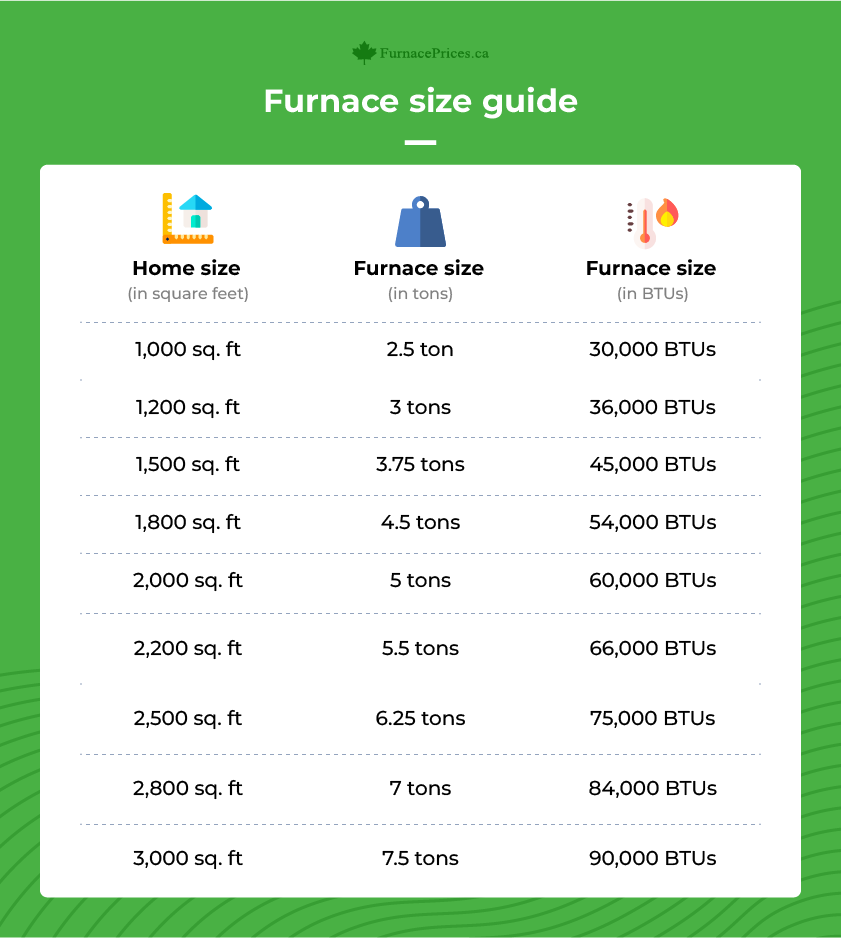
Image Source: www.furnaceprices.ca
Why Proper Furnace Sizing Matters
Selecting the correct furnace capacity is a cornerstone of an efficient and effective home heating system. It’s not just about matching a number; it’s about creating a balanced environment.
- Comfort: A properly sized furnace maintains a consistent temperature throughout your home, eliminating hot and cold spots.
- Energy Efficiency: Furnaces that are the right size operate at peak efficiency. Oversized units short-cycle, meaning they turn on and off more frequently than necessary. This start-and-stop action uses more energy than continuous, steady operation. Undersized units run longer to reach the thermostat setting, also leading to inefficiency.
- Equipment Longevity: Frequent cycling puts extra stress on components like the motor, igniter, and heat exchanger. A correctly sized furnace operates smoothly, reducing wear and tear and extending its lifespan.
- Air Quality: Proper airflow from a correctly sized furnace helps your air filtration system work more effectively, improving indoor air quality.
- Cost Savings: Efficient operation translates directly into lower utility bills. A properly sized system avoids the energy waste associated with oversizing or undersizing.
Deciphering the Core of Furnace Sizing: The Load Calculation
The heart of accurate furnace sizing lies in the load calculation. This is a detailed assessment of how much heat your home loses during the coldest periods. This isn’t a simple “one-size-fits-all” calculation; it’s a science that considers many factors unique to your home.
What is a Load Calculation?
A load calculation quantifies the amount of heat your home needs to maintain a comfortable temperature, typically measured in British Thermal Units (BTUs) per hour. This calculation determines the required furnace capacity. The goal is to match the furnace’s output to the home’s heat loss.
The Manual J Standard: The Industry Benchmark
In the HVAC industry, Manual J is the gold standard for performing load calculations. Developed by the Air Conditioning Contractors of America (ACCA), Manual J provides a standardized methodology for assessing heat loss and heat gain in residential buildings. Relying on a contractor who uses Manual J is the most reliable way to ensure your furnace is sized correctly.
Key Factors in a Manual J Load Calculation
A thorough Manual J calculation involves examining numerous aspects of your home’s construction and environment.
Home Characteristics
- Square Footage: The total heated living area of your home.
- Number of Rooms and Layout: The number and arrangement of rooms affect airflow and heating distribution.
- Ceiling Height: Higher ceilings mean a larger volume of air to heat.
- Home Type: Single-family home, townhome, condo, etc., each have different thermal properties.
- Basement Type: Finished, unfinished, crawl space, or slab foundation all impact heat loss.
Building Envelope
- Insulation Levels: The amount and type of insulation in walls, attics, and floors are critical for preventing heat loss. Higher R-values mean better insulation and less heat loss.
- Window Type and Size: Double-pane, triple-pane, low-E coatings, and the overall window-to-wall ratio significantly influence heat loss.
- Door Type and Sealing: Well-insulated and properly sealed doors are essential.
- Air Infiltration: How “tight” your home is. Drafty homes lose more heat through air leaks around windows, doors, electrical outlets, and other penetrations.
Climate and Location
- Outdoor Design Temperature: The expected lowest outdoor temperature for your specific geographic region. This is a crucial variable in determining the maximum heat needed.
- Indoor Design Temperature: The desired temperature you want to maintain inside your home.
- Wind Exposure: Homes in windy areas experience greater heat loss.
- Solar Heat Gain: Sunlight entering through windows can contribute to heat gain in the summer and, to a lesser extent, can offset some heat loss in the winter, though this is more critical for cooling calculations.
Internal Heat Gains
- Occupancy: People generate body heat.
- Appliances and Lighting: Heat emitted by stoves, ovens, computers, and lights contributes to the overall heat within the home. While these are more heavily weighted in cooling load calculations, they can play a minor role in heating.
Beyond Manual J: Other Sizing Considerations
While Manual J provides the foundation, other ACCA standards complement it for a complete HVAC sizing picture.
- Manual S (Equipment Selection): This standard guides the selection of specific HVAC equipment based on the Manual J load calculation results. It helps choose a unit with the appropriate furnace capacity and features.
- Manual D (Duct Design): This standard ensures that the ductwork system is properly designed to deliver the heated air efficiently and quietly throughout the house. Poor ductwork can negate the benefits of a perfectly sized furnace.
Calculating Furnace Capacity: The BTU Equation
The output of a furnace is measured in BTUs per hour (BTU/hr). A BTU is the amount of heat needed to raise the temperature of one pound of water by one degree Fahrenheit. To determine the required furnace capacity, the load calculation will result in a specific BTU/hr value.
Simple Approximation (Not Recommended for Final Decision)
While not a substitute for a professional load calculation, understanding the concept of BTU calculation can be helpful. A very rough, often inaccurate, method involves multiplying square footage by a factor.
- General Rule of Thumb (Use with Extreme Caution): Some sources suggest multiplying the square footage of your home by a factor ranging from 40 to 60 BTU/hr. For example, a 2,000 sq ft home might be estimated at 80,000 to 120,000 BTU/hr.
Why this is insufficient: This method fails to account for insulation, window quality, climate, and numerous other crucial factors. Using this alone can lead to significant sizing errors.
The Role of AFUE (Annual Fuel Utilization Efficiency)
When selecting a furnace, you’ll encounter the AFUE rating. This percentage indicates how efficiently the furnace converts fuel into heat.
- High-efficiency furnaces have AFUE ratings of 90% or higher, meaning 90% or more of the fuel consumed is converted into usable heat.
- Conventional furnaces typically have AFUE ratings between 70% and 85%.
Important Note: The AFUE rating does not affect the BTU calculation or the required furnace capacity. It tells you how much of that capacity is actually delivered as heat. If your load calculation calls for 80,000 BTU/hr of heat output, and you choose a furnace with an 80,000 BTU/hr input rating and 90% AFUE, it will deliver 72,000 BTU/hr of heat. You must select a furnace with an input rating that, when multiplied by its AFUE, meets your calculated heating load. Always confirm with your HVAC professional what the BTU rating refers to – input or output. Reputable contractors will specify the input BTU rating.
Common Furnace Sizing Mistakes and How to Avoid Them
Many homeowners inadvertently contribute to furnace sizing errors, often without realizing it. Awareness is key to ensuring a good outcome.
Mistake 1: Relying on Old Equipment Size
Problem: Assuming the new furnace should be the same size as the old one.
Why it’s wrong: Homes are often renovated, insulation is added, or windows are replaced, changing the heating load. The old furnace might have been incorrectly sized in the first place.
Solution: Always perform a new load calculation when replacing an old system, regardless of the size of the previous unit.
Mistake 2: Using Online Calculators Exclusively
Problem: Blindly trusting online calculators without professional verification.
Why it’s wrong: These calculators simplify complex factors. They may not account for specific insulation types, subtle air leaks, or the precise climate data for your micro-location.
Solution: Use online tools as a preliminary guide but always insist on a Manual J calculation from your HVAC contractor.
Mistake 3: Oversizing for “Extra Heat”
Problem: Believing a bigger furnace will heat the home faster or better.
Why it’s wrong: As discussed, oversizing leads to short cycling, uneven temperatures, and reduced efficiency. The goal is correct sizing, not oversized sizing.
Solution: Trust the Manual J report. A properly sized furnace is designed to handle your home’s worst-case heating scenarios efficiently.
Mistake 4: Ignoring Ductwork
Problem: Focusing solely on the furnace without considering the delivery system.
Why it’s wrong: Even a perfectly sized furnace can’t deliver heat effectively if the ductwork is undersized, leaky, or poorly designed. This is where Manual D comes in.
Solution: Ensure your HVAC contractor also assesses your ductwork’s condition and suitability for the new furnace.
Mistake 5: Confusing BTU Input vs. Output
Problem: Not clarifying whether the advertised BTU rating is for fuel input or heat output.
Why it’s wrong: A 100,000 BTU/hr input furnace with 80% AFUE only delivers 80,000 BTU/hr of heat.
Solution: Always ask your contractor to confirm the input BTU rating of the furnace they are recommending and ensure it aligns with the load calculation requirements.
The Furnace Sizing Process: What to Expect from a Professional
When you hire a qualified HVAC professional for furnace sizing, here’s what the process should look like:
1. Initial Consultation and Home Assessment
The technician will start by asking about your comfort preferences, any existing heating issues, and information about your home. They will then conduct a thorough inspection.
2. Performing the Manual J Load Calculation
This is the core of the process. The technician will meticulously gather data about your home’s construction, insulation, windows, doors, and local climate. This data is then entered into specialized software that performs the Manual J calculation.
3. Analyzing the Results
The software will output the required heating capacity in BTUs per hour for your home. This is your target furnace capacity.
4. Equipment Selection (Manual S)
Based on the Manual J results, the technician will recommend specific furnace models. They will consider:
- BTU Input Rating: Matching the calculated heating load.
- AFUE Rating: Discussing efficiency options and their cost-benefit.
- Fuel Type: Natural gas, propane, oil, or electric.
- Furnace Type: Upflow, downflow, horizontal, single-stage, two-stage, or variable-speed.
- Physical Dimensions: Ensuring the unit fits in the designated space.
5. Ductwork Evaluation (Manual D)
The technician will also assess your existing ductwork. If it’s inadequate, they might recommend modifications or replacements to ensure proper air delivery.
6. Proposal and Explanation
You will receive a detailed proposal outlining the recommended furnace, its specifications, installation details, and costs. The technician should be able to explain the load calculation results and why the recommended furnace is the best fit for your home heating system.
Related HVAC Sizing: Furnace vs. Air Conditioner
It’s important to note that furnace sizing and AC sizing are distinct but related processes within overall HVAC sizing.
- Furnace Sizing: Focuses on heat load (heat loss) during winter.
- AC Sizing: Focuses on cooling load (heat gain) during summer.
The Manual J calculation can be performed to determine both heating and cooling loads. However, the factors influencing heat loss and heat gain are different, so the final BTU requirements for heating and cooling will likely differ.
Common Misconception: Sometimes, people assume that if their air conditioner is a certain size (e.g., 3 tons, which is 36,000 BTU/hr of cooling), their furnace should be a comparable BTU size. This is incorrect. Cooling and heating loads are calculated using different methodologies and climate data. The required furnace capacity will not necessarily correlate directly with your AC unit’s tonnage.
Interplay with AC Sizing
When replacing a furnace and AC unit simultaneously, a comprehensive HVAC sizing approach is best. The Manual J calculation for both heating and cooling loads will inform the selection of both pieces of equipment. Ensuring both are correctly sized contributes to a balanced and efficient HVAC system.
Furnace Capacity and Types of Furnaces
The required furnace capacity will dictate the specific model you choose. Furnaces come in various types, each impacting performance and efficiency.
Single-Stage Furnaces
- Operation: These furnaces operate at one speed – full blast or off.
- Pros: Generally less expensive to purchase.
- Cons: Can lead to temperature fluctuations, less energy-efficient due to constant starting and stopping.
- Best For: Smaller homes or areas with mild winters where extreme temperature control isn’t paramount.
Two-Stage Furnaces
- Operation: These furnaces have two levels of heat output: a lower stage for milder days and a higher stage for colder days.
- Pros: More consistent temperatures, better energy efficiency than single-stage, quieter operation.
- Cons: More expensive than single-stage units.
- Best For: Homes where consistent comfort and moderate energy savings are desired.
Modulating (Variable-Speed) Furnaces
- Operation: These furnaces can adjust their heat output in very small increments, precisely matching the heating load.
- Pros: Offer the most consistent temperatures, highest energy efficiency, quietest operation, and best humidity control.
- Cons: The most expensive option upfront.
- Best For: Homeowners prioritizing ultimate comfort, maximum energy savings, and advanced climate control.
When your load calculation is finalized, the technician will suggest furnace types that are available within the required furnace capacity range and that align with your budget and comfort goals.
Maintaining Your Right-Sized Furnace
Once your furnace is correctly sized and installed, proper maintenance is key to ensuring it operates efficiently for years to come.
- Annual Inspections: Have a qualified technician inspect and service your furnace annually. They will check for proper operation, clean components, and identify any potential issues.
- Filter Replacement: Change your furnace filter regularly, typically every 1-3 months, depending on the filter type and household conditions. A clogged filter restricts airflow, making the furnace work harder and reducing efficiency.
- Clear Vents: Ensure that all air vents and registers in your home are not blocked by furniture or drapes.
Frequently Asked Questions (FAQ)
Q1: How much does it cost to get a furnace sized?
The cost of performing a load calculation and providing a quote is typically included in the service fee for furnace replacement or installation. Some companies may charge a small fee for a detailed Manual J report if you’re not immediately proceeding with an installation, but this is often waived if you hire them for the job.
Q2: Can I use the size of my old furnace’s BTU rating to buy a new one?
No, it’s strongly advised against. Homes change, and older installations may not have been sized correctly. Always get a new load calculation using Manual J.
Q3: What is the difference between furnace input and output BTU?
Input BTU is the amount of energy the furnace consumes from the fuel source (e.g., natural gas). Output BTU is the actual amount of heat delivered into your home after accounting for the furnace’s efficiency (AFUE). Your load calculation determines the required output BTU, and you then select an input BTU furnace with an appropriate AFUE to meet that need.
Q4: Does a bigger house always need a bigger furnace?
Not necessarily. A larger, well-insulated, and energy-efficient home might require a smaller furnace than a smaller, poorly insulated home. The load calculation is the only accurate way to determine the required furnace capacity.
Q5: How does furnace sizing affect my air conditioner?
While distinct, both systems are part of your HVAC sizing. A properly balanced system ensures that the ductwork and overall airflow can adequately support both heating and cooling. While AC sizing and furnace sizing are independent calculations, a professional will consider them together for optimal system performance.
Q6: What is a “rule of thumb” for furnace sizing?
While rules of thumb like “40-50 BTU per square foot” exist, they are highly inaccurate and should not be used for final purchasing decisions. A professional load calculation using Manual J is essential for accurate residential furnace sizing.
Conclusion
Sizing a furnace is a critical step in ensuring your home remains comfortable and your energy bills remain manageable. By prioritizing a professional load calculation, ideally performed using the Manual J standard, you empower yourself to make informed decisions about your home heating system. Remember that accurate furnace sizing is not just about the numbers; it’s about the intricate interplay of your home’s construction, insulation, local climate, and your comfort preferences. Don’t shortcut this vital process. Invest in a proper assessment to guarantee your new furnace delivers efficient, reliable warmth for years to come, complementing your overall HVAC sizing strategy.